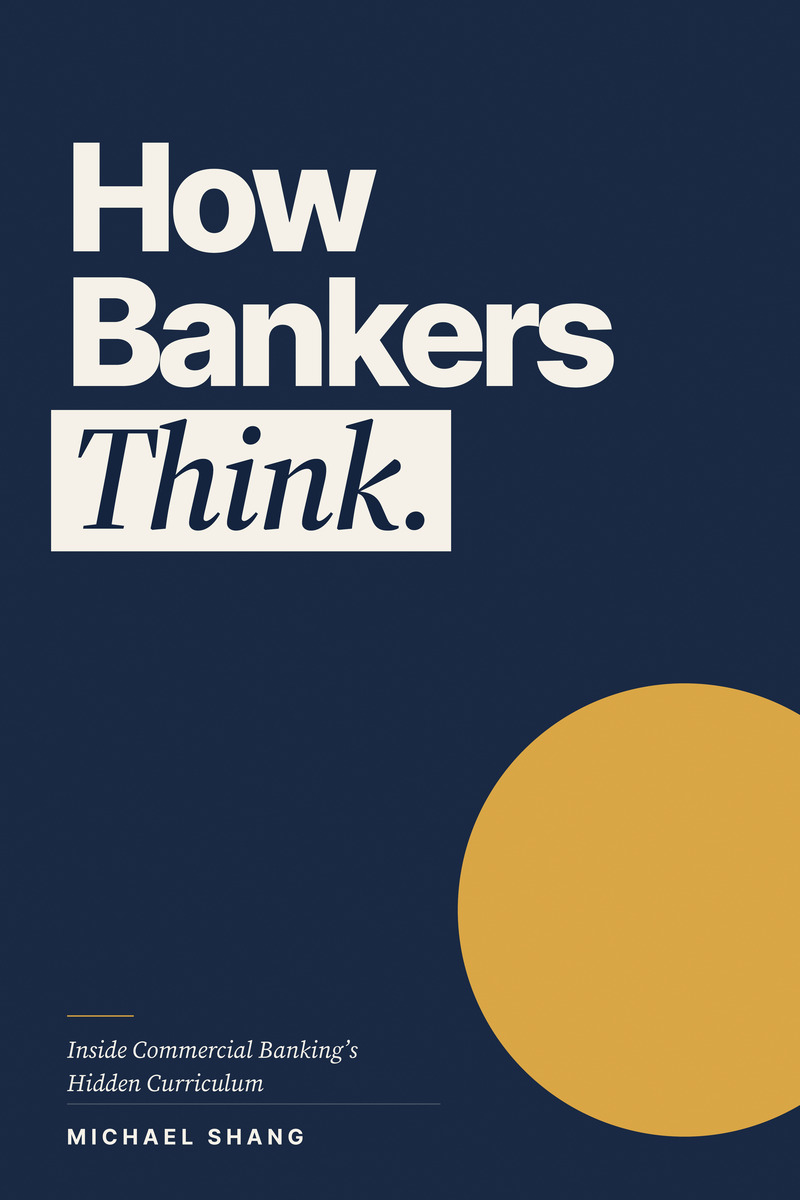
How Bankers Think
Inside Commercial Banking's Hidden Curriculum
By Michael Shang
How do I get my money back, with interest, across cycles?
Every framework in this book — the Three Diagnostics, the Quality of Earnings Triangulation, the Lendability Matrix, the Walk-Away Framework — is, in some form, a structured way of answering this single sentence.
The hidden curriculum, written down.
Commercial banking has a hidden curriculum. It is not in the textbooks and rarely makes it into formal training. It lives in the questions a senior banker quietly works through before saying yes, no, or “let's structure it differently” — and in the instincts that tell them which question matters most for this borrower, on this day, in this cycle.
This book is the explicit version of what experienced bankers have internalised: the frameworks senior bankers actually use, the dispositions they listen for, and the disciplines that produce careers of durable judgement across cycles. The technical content of banking is learnable in a year. The temperament takes longer — and is the actual subject of every interview, every credit committee, every client meeting.
Each chapter develops one instrument of that temperament. Worked judgement, not formulas. The frameworks are what practitioners actually use; the cases are composite illustrations constructed for teaching.
The frameworks are the scaffolding.
The disposition is the work.
Will I get paid back?
Does the borrower have the cash flows, the assets, the business model, and the resilience to repay across the tenor — including across whatever cyclical or competitive stress arrives during it? The largest of the three questions; Chapters 3–6 are structured methods for arriving at a defensible answer.
Am I being paid enough for the risk?
Not just the spread. The full economics: fees, ancillary business, relationship value across years, capital weighting, operational cost of holding the exposure. A facility well-priced on spread alone may be a poor return; a facility priced aggressively may be strong long-term.
Can I get out if I'm wrong?
The structural question. Even the best Question One analysis can be wrong. Tenor, security, covenants, amortisation, borrowing bases — the design of the protections that get the principal back when the original story doesn't hold. The discipline that separates senior judgement from competent judgement.
Contents
Eight chapters · 370 pages
- 01
Why Bankers Think Differently
Framework · The Three Questions
Commercial banking is a profession defined by a particular temperament — older and deeper than the technical knowledge the recruiting process appears to test for. The chapter introduces the three questions that sit underneath every credit decision.
- 02
The Hidden Curriculum
Framework · The Four Signals
What is actually being tested in a commercial banking interview, beneath every printed question — and how to read the room the way a banker reads a financial statement: not for what is asked on the surface, but for what is looked for underneath.
- 03
Reading Real Demand vs. Plugging Holes
Framework · The Three Diagnostics
The most foundational of credit instincts — distinguishing the borrower who needs capital because they are growing from the borrower who needs capital because they are deteriorating. Three independent diagnostics, run in parallel, on any working capital request.
- 04
Reading the Numbers Behind the Numbers
Framework · Quality of Earnings Triangulation
Financial statements as documents prepared by humans with incentives. Three angles run in parallel — profit-to-cash conversion, balance sheet velocity, and the language of disclosure — to test whether the reported profit is real enough to lend against.
- 05
Reading the Industry, Not Just the Borrower
Framework · The Lendability Matrix and Where It Breaks
No borrower can be properly understood without the cyclical, structural, and competitive context of the industry around them. The Lendability Matrix — plus cycle position and concentration — is a way of thinking about which industries can support which kinds of debt, and where that logic breaks.
- 06
Spotting Trouble Before It Spots You
Framework · The Three Modes of Watching
Pattern watching, coupling watching, silence watching. A method for maintaining attuned attention across a portfolio so that early recognition becomes a reliable output rather than occasional luck. The banker at twelve months has different options than the banker at three.
- 07
The Deal You Don't Do
Framework · Four Scenarios and Four Self-Tests
The long arc of a banker's career is shaped more by what they decline than by what they accept. The Walk-Away Framework — four scenarios, four self-tests — integrates all three questions into a single defensible call. The closest the book comes to a meditation on the moral architecture of the work.
- 08
Reading the Room: The Banker as Translator
Framework · The Three Translations
The technical judgement developed across the earlier chapters is, in the end, an instrument of translation — making businesses legible to the processes that decide whether they get funded. Cycle versus calendar, visible versus actual, slice versus flow.
The opening of Chapter 1, free to read on the website.
The student preparing for interviews.
For finance students and career-switchers walking into commercial banking interviews. The book gives the underlying way of thinking the standard preparation guides leave out — before the room itself reveals it.
The junior banker, six to eighteen months in.
For bankers who can do the spreading but cannot yet see the shape of a deal. The frameworks senior bankers actually use, the dispositions they listen for, made explicit a few years earlier than they otherwise would be.
The professional across the table.
For lawyers, accountants, advisors, and founders who sit opposite bankers and want a usable account of the worldview those bankers operate from when they do.
Questions
The book · the author · the imprint
- What is How Bankers Think about?
- How Bankers Think is a field guide to the worldview senior commercial bankers actually develop and use — the frameworks, dispositions, and disciplines behind durable credit judgement across cycles. Its argument is that commercial banking is defined less by technical content, which is learnable in about a year, than by a temperament that takes far longer to build. Eight chapters, 370 pages, first edition 2026.
- Is How Bankers Think about investment banking?
- No. It is about commercial banking — lending to businesses, and the credit judgement that sits behind it. The book is explicit that the temperament commercial banking selects for differs from the one rewarded in investment banking, private equity, consulting, or corporate strategy: it moves toward what could go wrong before what could go right.
- Who is How Bankers Think for?
- Three readers. Students and career-switchers preparing for commercial banking interviews, who want the underlying way of thinking the standard preparation guides leave out. Junior bankers six to eighteen months in, who can do the spreading but cannot yet see the shape of a deal. And the professionals across the table — lawyers, accountants, advisors, and founders — who want a usable account of the worldview their banker operates from.
- What frameworks does the book teach?
- Eight, one per chapter: the Three Questions, the Four Signals, the Three Diagnostics, Quality of Earnings Triangulation, the Lendability Matrix, the Three Modes of Watching, the Walk-Away Framework (four scenarios and four self-tests), and the Three Translations. Each is a structured way of answering one sentence: how do I get my money back, with interest, across cycles?
- What are the Three Questions in How Bankers Think?
- Will I get paid back — does the borrower have the cash flows, assets, business model, and resilience to repay across the tenor? Am I being paid enough for the risk — not just the spread, but fees, ancillary business, relationship value, capital weighting, and the operational cost of holding the exposure? And can I get out if I'm wrong — the structural question of tenor, security, covenants, amortisation, and borrowing bases.
- Who wrote How Bankers Think?
- Michael Shang, a commercial banker based in Auckland, Aotearoa New Zealand. He has spent sixteen years across commercial banking, including Bank of China in Beijing, the founding team of a Chinese bank's New Zealand branch, and senior roles in mainstream New Zealand commercial banking, spanning credit, structuring, and client coverage through several full credit cycles.
- Can I read part of How Bankers Think before buying it?
- Yes. The opening of Chapter 1, "Why Bankers Think Differently", is free to read in full on the Highbank Press website at highbankpress.com/books/how-bankers-think/sample. No email address or sign-up is required.
- Where can I buy How Bankers Think?
- On Amazon, distributed worldwide. Paperback ISBN 978-1-0672833-0-8, ebook ISBN 978-1-0672833-1-5, hardcover ISBN 978-1-0672833-2-2. World rights are held by Highbank Press and handled in-house.
- Is there a companion resource to the book?
- Yes. Banking Judgment Lab at bankingjudgmentlab.com is a free companion project — interactive case drills and credit diagnostics that let readers practise the questions the book sets out.
- What is Highbank Press?
- Highbank Press is an independent publisher based in Auckland, Aotearoa New Zealand, founded in 2026. It publishes working books written by experienced practitioners for the people who will do the work next — deliberately small, one title at a time, edited carefully. Its first title is How Bankers Think.
- Does Highbank Press accept manuscript submissions?
- Not unsolicited ones. Future titles are commissioned by invitation. Experienced practitioners who think their work fits the imprint are welcome to send a short note of introduction to hello@highbankpress.com with the subject line SUBMISSION; it is kept on file.
"Michael Shang puts words around instincts that senior bankers carry but rarely articulate clearly."
"A thoughtful and well-judged perspective on how bankers evaluate risk and opportunity."
"Most borrowers only understand how their banker thinks once a facility is under stress. Michael Shang explains that thinking before things go wrong."
"Michael Shang bridges accounting analysis and credit judgment with rare clarity… essential reading for finance professionals."
Format
Paperback & eBook
Pages
370
Publication
First edition · 2026
ISBN
978-1-0672833-0-8
Rights
World